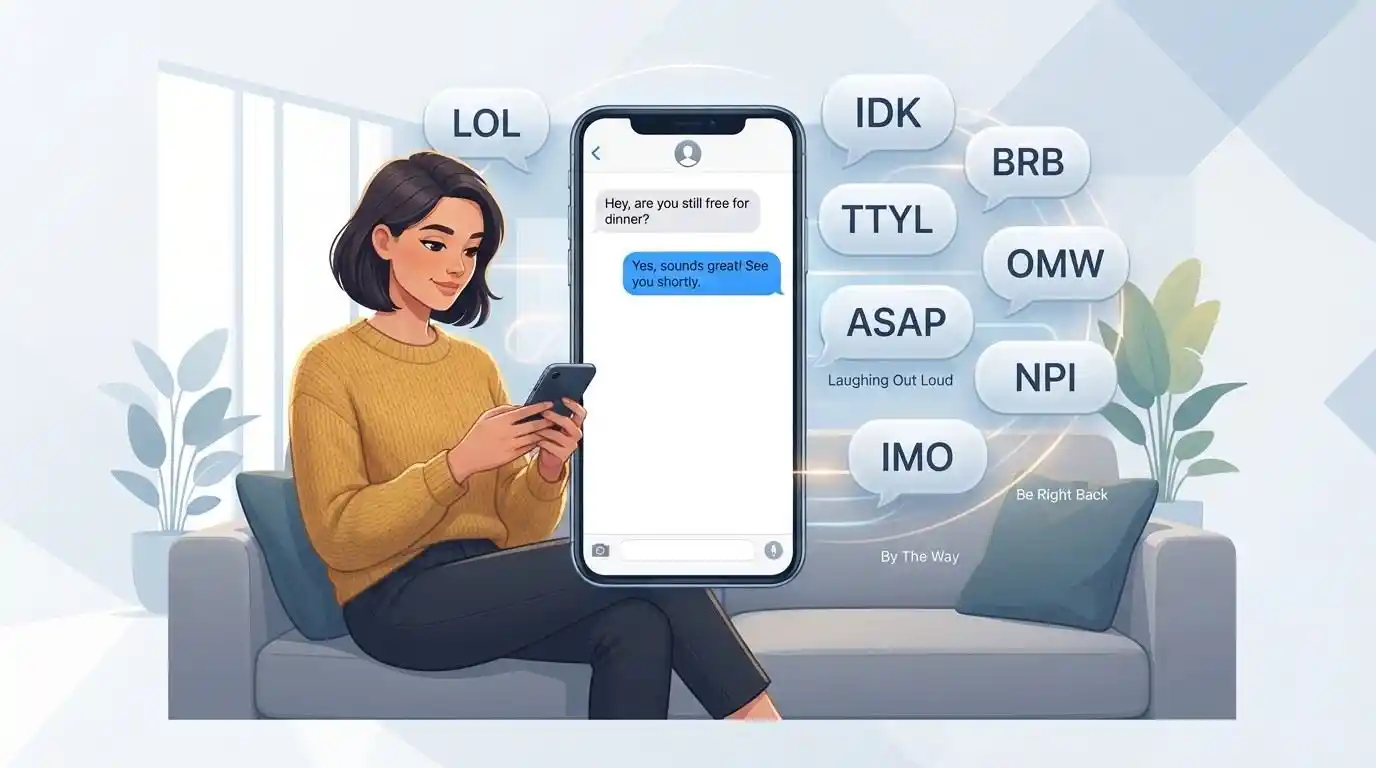
Basic conversation abbreviations are shortened forms of common words and phrases used in texts, chats, DMs, and social media. Examples include IDK (“I don’t know”), LOL (“laugh out loud”), BRB (“be right back”), BTW (“by the way”), and TTYL (“talk to you later”).
Key Takeaways
- Conversation abbreviations make casual digital communication shorter and faster.
- Common examples include IDK, LOL, BRB, BTW, OMG, TBH, FYI, LMK, and TTYL.
- Most are informal and are best suited to texting, DMs, group chats, and social media.
- The same abbreviation can have a different tone depending on punctuation, emojis, and context.
- Some abbreviations are suitable for workplace messaging, while others are better kept between friends.
- IDK, for example, normally means “I don’t know” and does not automatically indicate disinterest or rudeness.
Basic Conversation Abbreviations Meaning
Basic conversation abbreviations are texting abbreviations, internet slang, and messaging shorthand that replace frequently used words or sentences.
They are especially useful in quick online conversations where people want to respond naturally without typing every word. Common examples include IDK for “I don’t know,” BTW for “by the way,” BRB for “be right back,” and IMO for “in my opinion.”
These abbreviations are generally associated with informal digital communication. Their meaning is usually straightforward, but the tone can change according to the surrounding conversation.
For example:
“IDK what time we’re leaving.”
means:
“I don’t know what time we’re leaving.”
The abbreviation does not change the basic meaning; it simply makes the message shorter and more conversational.
What Do Basic Conversation Abbreviations Stand For?
Most conversation abbreviations are formed from the first letters of words in a familiar phrase. For example:
| Abbreviation | Full Form | Meaning in Conversation |
|---|---|---|
| IDK | I Don’t Know | Shows uncertainty or lack of information |
| LOL | Laugh Out Loud | Shows amusement or a humorous reaction |
| BRB | Be Right Back | Says the sender is temporarily leaving |
| BTW | By The Way | Introduces additional information |
| OMG | Oh My God | Shows surprise, excitement, or shock |
| TBH | To Be Honest | Introduces a candid opinion |
| FYI | For Your Information | Gives useful information |
| LMK | Let Me Know | Asks someone to provide information later |
| TTYL | Talk To You Later | Ends a conversation temporarily |
| IMO | In My Opinion | Introduces a personal view |
| NVM | Never Mind | Withdraws or dismisses a previous point |
| RN | Right Now | Refers to the current moment |
| ASAP | As Soon As Possible | Requests something quickly |
| JK | Just Kidding | Shows that a previous statement was a joke |
| IKR | I Know, Right? | Shows agreement |
| TY | Thank You | Expresses thanks |
| NP | No Problem | Shows that something is not an issue |
| YW | You’re Welcome | Responds to thanks |
| OMW | On My Way | Says the sender is traveling toward a place |
These are among the common shorthand forms found in texting and instant messaging.
How Are Basic Conversation Abbreviations Used?
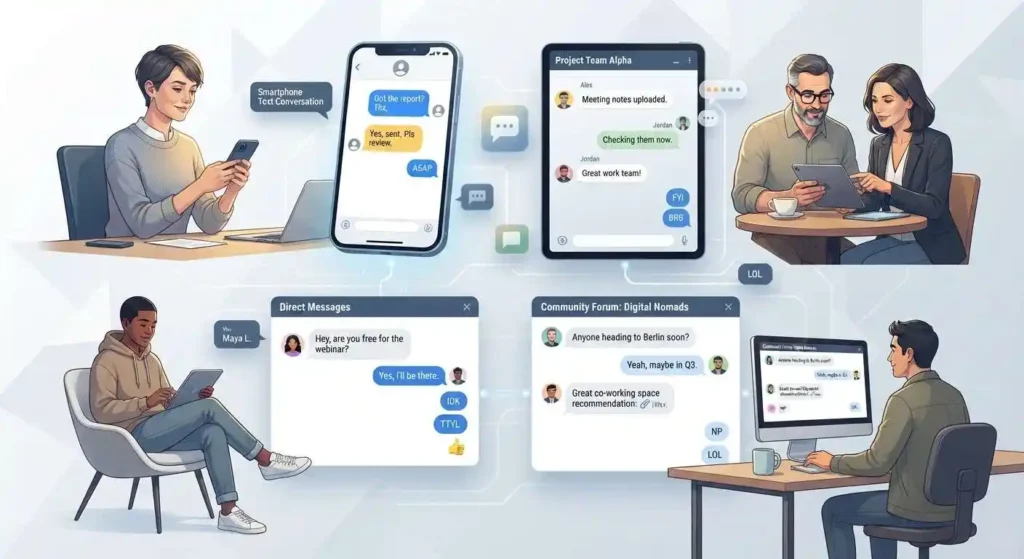
Conversation abbreviations appear in text messages, private messages, group chats, comments, social media posts, and online communities.
Text Messages
People commonly use abbreviations for quick everyday exchanges.
Example:
“BRB, someone’s at the door.”
Group Chats
Short forms can make fast-moving conversations easier to follow.
“BTW, are we still meeting at 7?”
Instagram and TikTok
Abbreviations can appear in comments, captions, replies, and DMs.
“OMG this is so good 😂”
Friends and family may use simple abbreviations when making plans or chatting casually.
“LMK when you get home.”
Discord and Gaming Chats
Short forms are useful when people need to communicate quickly.
“GTG, dinner’s ready.”
Not every abbreviation belongs in every setting. Highly casual slang can be confusing or inappropriate in professional communication.
Common Basic Conversation Abbreviations
Here are some of the most useful abbreviations for beginners.
| Abbreviation | Meaning | Example |
|---|---|---|
| IDK | I don’t know | “IDK what happened.” |
| LOL | Laugh out loud | “LOL, that was funny.” |
| BRB | Be right back | “BRB, getting coffee.” |
| BTW | By the way | “BTW, I found your book.” |
| OMG | Oh my God | “OMG, look at this!” |
| TBH | To be honest | “TBH, I prefer the first one.” |
| FYI | For your information | “FYI, the time changed.” |
| LMK | Let me know | “LMK when you’re free.” |
| TTYL | Talk to you later | “I have to go. TTYL!” |
| IMO | In my opinion | “IMO, that one looks better.” |
| NVM | Never mind | “NVM, I found it.” |
| RN | Right now | “I’m busy RN.” |
| ASAP | As soon as possible | “Please send it ASAP.” |
| JK | Just kidding | “I’m taking your fries. JK!” |
| IKR | I know, right? | “That movie was amazing.” — “IKR!” |
| TY | Thank you | “TY for helping me.” |
| NP | No problem | “NP, anytime.” |
| YW | You’re welcome | “YW!” |
| OMW | On my way | “OMW, see you soon.” |
| HMU | Hit me up | “HMU when you’re available.” |
Real Chat Examples
- IDK
“What time does the movie start?”
“IDK, I’ll check.” - LOL
“He actually wore two different shoes.”
“LOL, seriously?” - BRB
“Can you wait a minute?”
“BRB, I need to grab my phone.” - BTW
“BTW, your package arrived.” - OMG
“OMG, did you see that?” - TBH
“TBH, I think the first option is better.” - FYI
“FYI, tomorrow’s meeting starts at 10.” - LMK
“LMK if you want to come with us.” - TTYL
“I’m heading out now. TTYL.” - IMO
“IMO, this restaurant is better.” - NVM
“Where are my keys?”
“NVM, found them.” - RN
“Can you talk?”
“Not RN, I’m working.” - JK
“I ate your last cookie. JK!” - IKR
“That ending was chaotic.”
“IKR?” - NP
“Sorry for the late reply.”
“NP!” - TY
“TY for sending that.” - YW
“Thanks for the help!”
“YW!” - OMW
“Where are you?”
“OMW.” - ASAP
“Can you send me the address ASAP?” - HMU
“HMU when you’re done with class.”
How to Reply to Conversation Abbreviations
The right response depends on what the abbreviation means and the surrounding conversation.
Casual Replies
For simple abbreviations such as IDK, BTW, or LOL, a normal conversational response is usually enough.
“IDK what to eat.”
“Let’s just get pizza.”
Friendly Replies
When someone uses an abbreviation casually, you can answer in the same relaxed style.
“TY!”
“NP 😊”
Funny Replies
Some abbreviations create opportunities for playful responses.
“IDK.”
“That’s a very detailed answer 😂”
Neutral Replies
If the conversation is practical, keep your answer straightforward.
“LMK when you arrive.”
“Sure, I will.”
Flirty/Relationship Replies
Abbreviations do not automatically make a message romantic. If the conversation is already flirty, you can match that tone.
“HMU when you’re free 😉”
“Maybe I will.”
The relationship context matters more than the abbreviation itself.
Context & Relationship Meaning
Basic conversation abbreviations generally keep the same dictionary meaning regardless of who uses them.
For example, IDK from a guy, IDK from a girl, or IDK from a friend all normally mean “I don’t know.” What changes is the context surrounding the message.
In dating or relationship conversations, however, the same abbreviation can carry different emotional shades. For example:
“IDK, maybe.”
could indicate uncertainty about plans.
But:
“IDK how I feel about it.”
could express emotional uncertainty.
That does not automatically mean the person is rejecting you, losing interest, or hiding romantic feelings. Look at the complete conversation, wording, punctuation, emojis, and previous messages.
What Tone Do Basic Conversation Abbreviations Have?
The tone depends on the specific abbreviation.
- IDK — usually neutral or uncertain
- LOL — amused, playful, or lighthearted
- BRB — casual and practical
- BTW — conversational
- TBH — candid or direct
- OMG — surprised or excited
- JK — playful
- NVM — casual, sometimes abrupt
- IDC — can sound blunt or dismissive
- ILY — affectionate and personal
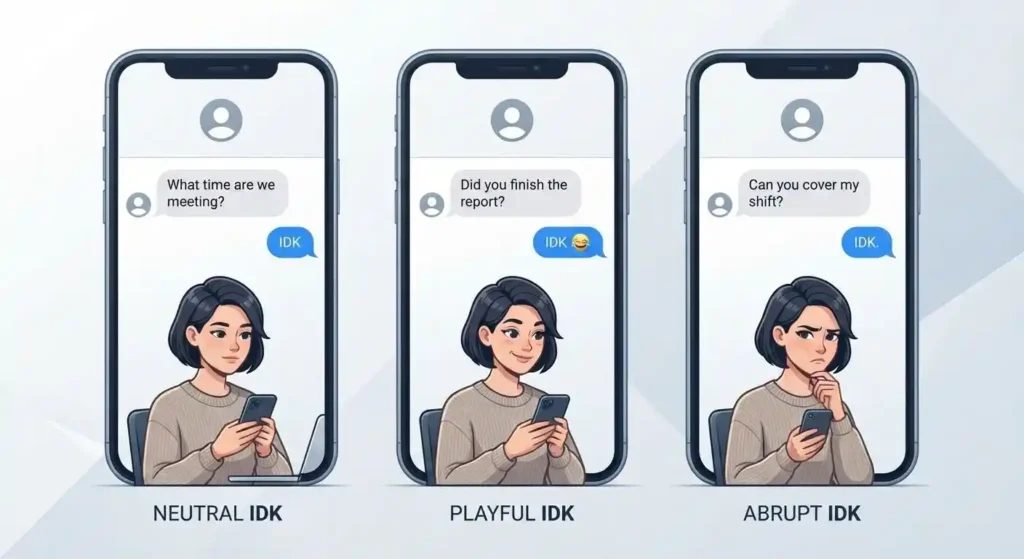
Even a neutral abbreviation can sound different when punctuation changes.
Compare:
“IDK”
with:
“IDK 😂”
and:
“IDK.”
The words are the same, but the surrounding signals can make the messages feel different.
Are Basic Conversation Abbreviations Rude or Offensive?
Most basic conversation abbreviations are not inherently rude or offensive. They are simply informal forms of communication.
They are generally appropriate for:
- Friends
- Family
- Casual texting
- DMs
- Group chats
- Informal social media conversations
Use more caution with:
- Teachers
- Formal school assignments
- Job applications
- Business emails
- Official documents
- Professional messages
For example, “IDK” may be perfectly natural in a message to a friend, while “I’m not sure” is usually clearer in a professional email.
Some abbreviations can also contain profanity or sexual language, so not every texting abbreviation is suitable for every audience.
Other Meanings of Conversation Abbreviations
Unlike a single abbreviation such as IDK, the phrase basic conversation abbreviations refers to a category rather than one fixed acronym.
Some abbreviations can also have different meanings in specialized fields. For example, ATM can mean “at the moment” in texting but refer to an automated teller machine in everyday non-chat contexts. ETA can mean “estimated time of arrival,” while other fields may use the same letters differently.
The safest way to interpret an abbreviation is to consider the sentence and the setting in which it appears.
Basic Conversation Abbreviations vs. Similar Slang
Abbreviations and slang overlap, but they are not exactly the same thing.
| Term | Meaning | Difference |
|---|---|---|
| IDK | I don’t know | A direct abbreviation of a common phrase |
| IDC | I don’t care | Expresses lack of concern rather than uncertainty |
| IMO | In my opinion | Introduces a personal viewpoint |
| TBH | To be honest | Signals a candid statement |
| NGL | Not gonna lie | Similar to TBH but more conversational |
| LOL | Laugh out loud | Expresses amusement or a light reaction |
| IKR | I know, right? | Shows agreement |
| BRB | Be right back | Indicates a temporary break from chatting |
For example, IDK and IDC are easy to confuse, but they communicate very different ideas:
IDK = I don’t know.
IDC = I don’t care.
Common Mistakes About Basic Conversation Abbreviations
Assuming Every Abbreviation Is Slang
Some are simply shortened forms used for convenience. Terms such as ASAP and FYI can appear in professional communication, although their suitability depends on the setting.
Assuming Short Means Rude
A one-word abbreviation can look abrupt, but that does not necessarily mean the sender is annoyed.
Treating Similar Abbreviations as Synonyms
IDK and IDC are a good example. One expresses uncertainty; the other expresses a lack of concern.
Assuming an Abbreviation Has Only One Meaning
Some abbreviations are context-dependent. Always consider the surrounding message.
Overinterpreting Relationship Messages
An abbreviation alone rarely tells you exactly how someone feels. The broader conversation provides much more useful context.
Related Internet Slang
| Term | Meaning | Common Use |
|---|---|---|
| NGL | Not gonna lie | Introducing an honest or candid thought |
| IKR | I know, right? | Agreeing with someone |
| SMH | Shaking my head | Disbelief, disappointment, or disapproval |
| FWIW | For what it’s worth | Offering an opinion or perspective |
| AFAIK | As far as I know | Qualifying information |
| IIRC | If I recall correctly | Indicating uncertain memory |
| IRL | In real life | Referring to offline life |
| TMI | Too much information | Reacting to excessive personal detail |
| FOMO | Fear of missing out | Talking about missing an event or experience |
| TL;DR | Too long; didn’t read | Giving or requesting a short summary |
These terms appear in broader internet and messaging vocabulary, but they do not all serve the same conversational purpose.
Real-World Conversation
Alex: Are you coming to dinner tonight?
Sam: IDK yet. I might have to work.
Alex: Okay, LMK when you know.
Sam: Sure. BTW, what time are you going?
Alex: Around 7.
Here, IDK expresses uncertainty, LMK asks for an update, and BTW introduces additional information.
People Also Ask
What is the most common texting abbreviation?
There is no single universal ranking that applies to every audience or platform. Familiar examples include IDK, LOL, BRB, BTW, OMG, and TTYL.
What does IDK mean in texting?
IDK means “I don’t know.” It is used when someone does not know something, is uncertain, or does not have a definite answer.
What does LOL mean in chat?
LOL traditionally means “laugh out loud.” In everyday online conversations, it can signal amusement or make a message feel lighter.
What does BRB mean in a text?
BRB means “be right back.” Someone uses it to tell you they are temporarily stepping away but expect to return to the conversation.
What does BTW mean in texting?
BTW means “by the way.” It is commonly used to introduce an additional detail, side note, or change of topic.
What does TBH mean in text?
TBH means “to be honest.” It usually introduces a candid opinion or statement.
Are texting abbreviations appropriate in professional messages?
Some widely understood abbreviations can be acceptable in informal workplace chats, depending on the organization and audience. For formal emails and documents, spelling out the phrase is usually clearer.
Why do people use abbreviations when texting?
They provide a quick way to express familiar phrases and can make casual conversations more efficient. They also fit naturally into the informal style of digital communication.
Conclusion
Basic conversation abbreviations are shortened forms used to make digital communication quicker and more casual. Familiar examples include IDK, LOL, BRB, BTW, TBH, OMG, LMK, and TTYL. Their meanings are usually easy to understand, but tone depends on context, punctuation, emojis, and the relationship between the people communicating. For formal or professional situations, writing the full phrase is often the safer choice.

Christopher Hayes is a writer focused on captions and quotes that capture moments, moods, and personal expressions. Over five years, he has worked across travel, lifestyle, relationships, events, social media, entertainment, and aesthetic themes. Christopher studies caption styles, refines wording choices, and structures short-form phrases to create clear, memorable lines suited to different occasions.