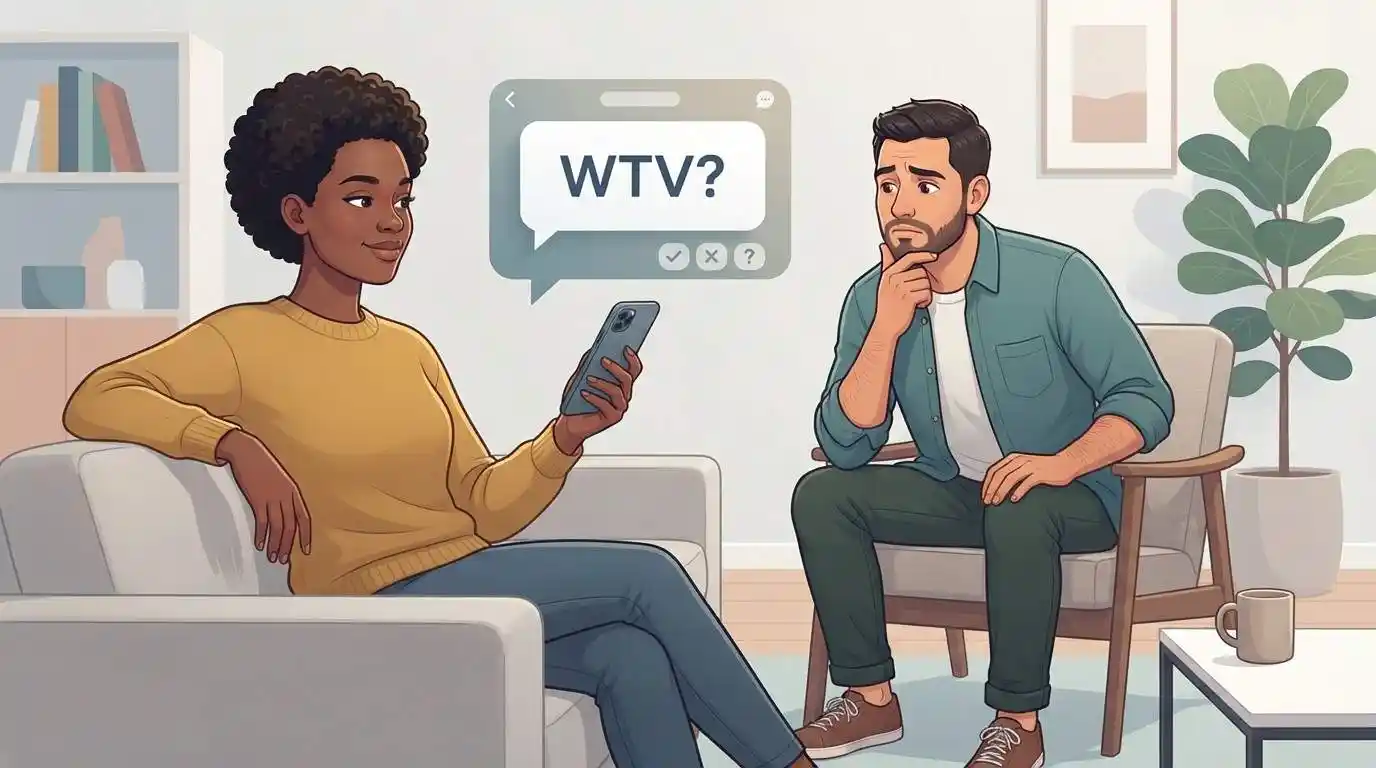
WTV means “whatever” in text. It is a casual texting abbreviation used to show that someone does not have a preference, does not mind, or wants to brush off a topic. Depending on context, it can sound relaxed, playful, indifferent, or dismissive.
Key Takeaways
- WTV means “whatever.”
- It is an informal texting abbreviation and internet slang term.
- It can express indifference, flexibility, lack of preference, or dismissal.
- The tone depends heavily on the surrounding conversation.
- WTV can appear in texts, DMs, group chats, comments, and social media.
- It is not automatically rude, angry, or romantic.
- WTV and IDC can overlap, but they do not always mean exactly the same thing.
WTV Meaning in Text
In texting, WTV means “whatever.” It is a shortened form of the word used in casual digital communication.
People often use WTV when they do not have a strong opinion about something. For example:
“Pizza or burgers?”
“WTV, you choose.”
Here, WTV means that either option is fine.
However, WTV can also sound dismissive:
“WTV. Do what you want.”
So, the definition stays the same, but the tone changes with context.
WTV is best understood as text slang, messaging shorthand, and social media slang rather than formal English.
What Does WTV Stand For?
WTV stands for “whatever.”
It is essentially a shortened written version of whatever, rather than a traditional acronym where each letter represents a separate word.
You may see it written as:
- WTV
- wtv
- Wtv
Capitalization usually does not change its meaning.
For example:
“Wtv works for me.”
means:
“Whatever works for me.”
How Is WTV Used?
WTV is mainly used in informal digital conversations when someone wants to express flexibility, indifference, or dismissal.

Text Messages
“What should we eat?”
“WTV, I’m fine with anything.”
Here, WTV means the person has no preference.
DMs
Someone may use WTV when responding casually to a suggestion:
“You can pick the movie.”
“WTV you want is fine.”
Group Chats
In group conversations, WTV can show that someone is willing to go with the group’s decision:
“Where are we meeting?”
“WTV everyone wants.”
Social Media
WTV can appear in casual comments, replies, and private messages. It may express anything from simple indifference to mild dismissal.
Snapchat
In short, casual conversations, WTV can be used as a quick replacement for “whatever.”
Gaming Chats
Players may use WTV when they have no preference:
“Which map?”
“WTV, you pick.”
The gaming context does not normally change the meaning.
Real Chat Examples
Example 1: No preference
A: “Pizza or burgers?”
B: “WTV, you choose.”
Example 2: Letting someone decide
A: “Which movie should we watch?”
B: “WTV you want.”
Example 3: Flexible about plans
A: “We can meet at 4 or 6.”
B: “WTV works for me.”
Example 4: Choosing dinner
A: “What do you want for dinner?”
B: “WTV, I’m not picky.”
Example 5: Choosing a game
A: “Which game should we play?”
B: “WTV, I’ll play either.”
Example 6: Group decision
A: “Beach or park?”
B: “WTV everyone wants.”
Example 7: Casual response
A: “Do you care which one I choose?”
B: “WTV.”
Example 8: Playful use
A: “I’m choosing the worst movie 😂”
B: “WTV, I’ll survive 😂”
Example 9: Changing the subject
A: “Are you still upset about yesterday?”
B: “WTV, forget it.”
Example 10: Mild frustration
A: “I think you’re wrong.”
B: “WTV. Believe what you want.”
Here, WTV sounds more dismissive because of the surrounding message.
Example 11: Social media conversation
A: “Did you like the new update?”
B: “WTV lol, I barely noticed.”
Example 12: Choosing a time
A: “Can we meet at 5 instead?”
B: “Yeah, wtv works.”
Example 13: No strong opinion
A: “Blue or black?”
B: “WTV looks better to you.”
Example 14: Friend conversation
A: “Should we study now or later?”
B: “WTV, I’m free.”
Example 15: During an argument
A: “You should have told me earlier.”
B: “WTV, it’s done now.”
Example 16: Relationship conversation
A: “Where do you want to go?”
B: “WTV you want. I just want to hang out.”
Example 17: Quick answer
A: “Do you want tea or juice?”
B: “WTV.”
Example 18: Online disagreement
A: “That game is definitely better.”
B: “WTV, everyone has an opinion.”
Example 19: With an emoji
A: “Which one should I get?”
B: “WTV you like 😂”
Example 20: Ending a topic
A: “Do you want to talk about it?”
B: “WTV. Let’s just leave it.”
How to Reply to WTV
Your best response depends on whether the sender is being casual, playful, or dismissive.
Casual Replies
- “Okay, you choose then.”
- “Sure, works for me.”
- “Alright.”
- “Cool.”
- “No preference?”
Friendly Replies
- “Haha okay, I’ll pick.”
- “Sure, I’ll decide.”
- “Either works for me too.”
- “Sounds good.”
- “No worries.”
Funny Replies
- “WTV is not an answer 😂”
- “Fine, I’m choosing then.”
- “Wow, very specific 😂”
- “You’re making me do all the decisions lol.”
Neutral Replies
- “Okay.”
- “Sure.”
- “Whatever works.”
- “No problem.”
- “Alright.”
Flirty/Relationship Replies
If the conversation is already playful or romantic, you can keep your response warm:
- “I’ll pick, then 😊”
- “Whatever? I’ll choose something good.”
- “Fine, but you’re coming with me.”
- “Okay, message me later.”
WTV itself does not prove romantic interest. The rest of the conversation matters much more.
Context & Relationship Meaning
What Does WTV Mean From a Guy?
From a guy, WTV generally means “whatever.” He may be saying that he has no preference, does not mind, or wants to move past a subject.
For example:
“WTV, you choose.”
sounds flexible.
But:
“WTV. Do what you want.”
can sound dismissive, especially during an argument.
The abbreviation alone does not prove that he is annoyed, interested, or uninterested.
What Does WTV Mean From a Girl?
From a girl, WTV normally has the same meaning: “whatever.”
She might be saying that she does not care which option is chosen, or she could be brushing off a topic.
Gender does not change the basic definition.
What Does WTV Mean From a Friend?
Between friends, WTV can be completely harmless:
“Where should we eat?”
“WTV, I’m hungry.”
Here, it simply means the friend has no strong preference.
What Does WTV Mean From a Crush?
If your crush sends WTV, it does not automatically mean they are angry, bored, or losing interest.
Compare:
“WTV you want 😊”
with:
“WTV. Whatever.”
The first can sound relaxed, while the second may feel more dismissive. The surrounding conversation provides the real context.
What Does WTV Mean in Dating?
In dating conversations, WTV can mean “whatever,” “I don’t mind,” or “you decide.”
It does not automatically indicate rejection or romantic interest. You need to consider the complete interaction.
What Does WTV Mean in a Relationship?
Partners can use WTV for everyday decisions:
“What should we watch?”
“WTV you want.”
During an argument, however, it can feel more dismissive:
“WTV, I’m done talking about it.”
The situation changes the tone, not the basic definition.
What Tone Does WTV Have?
WTV can have different tones depending on the context.
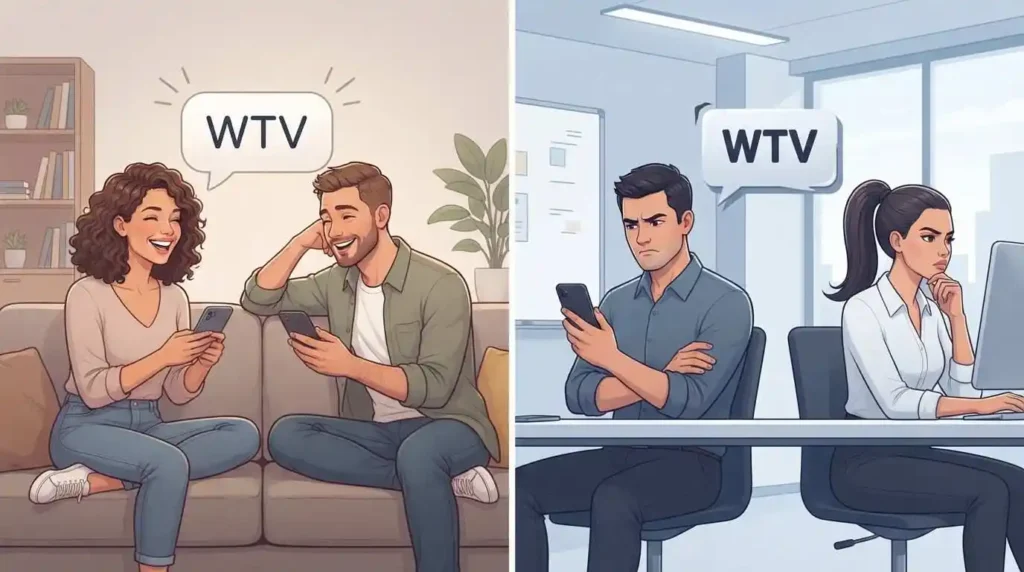
Casual
“WTV, you pick.”
The sender has no preference.
Relaxed
“WTV works for me.”
The sender is flexible.
Playful
“WTV 😂”
The emoji can make the response feel lighter.
Dismissive
“WTV.”
A very short response can suggest that the person does not want to continue the topic.
Annoyed
“WTV, do what you want.”
This can sound irritated when used during a disagreement.
Dry
“wtv”
A one-word response may feel emotionally flat, but it should not automatically be interpreted as anger or rejection.
Is WTV Rude or Offensive?
WTV is not inherently rude or offensive.
It is an informal abbreviation that works naturally in casual texts, DMs, group chats, and social-media conversations.
However, whatever can sound dismissive, so the complete message matters.
For example:
“WTV, I don’t care.”
sounds much harsher than:
“WTV, you can choose.”
For school, work, professional communication, and formal writing, it is better to use clearer, standard language instead of WTV.
Who Uses WTV?
WTV is informal digital shorthand used in casual online communication. It should not automatically be described as exclusively Gen Z slang or assigned to one particular generation.
Its main distinction is that it belongs to informal messaging, rather than formal written communication.
Other Meanings of WTV
For the phrase “WTV meaning in text,” the important meaning is “whatever.”
The same letters may appear as an abbreviation in specialized contexts, but those meanings are separate from everyday texting slang.
When WTV appears in a casual message such as:
“WTV, you choose.”
the intended meaning is “whatever.”
WTV vs. Similar Slang
| Term | Meaning | Main Difference |
|---|---|---|
| WTV | Whatever | Can show indifference, flexibility, or dismissal |
| IDC | I Don’t Care | More directly expresses lack of concern |
| IDK | I Don’t Know | Shows uncertainty or lack of knowledge |
| NVM | Never Mind | Usually drops or withdraws a topic |
| BRB | Be Right Back | Means the person is temporarily leaving |
| TBH | To Be Honest | Introduces an honest opinion |
The most easily confused terms are WTV and IDC.
They can overlap, but WTV is not always as strong as “I don’t care.” Someone saying “WTV, you choose” may simply be flexible, while “IDC” more directly communicates a lack of concern.
Common Mistakes About WTV
A common mistake is assuming that every WTV message is rude. Sometimes it simply means the sender does not have a preference.
Another mistake is interpreting WTV as “I don’t care about you.” That is much stronger than the normal meaning.
People can also assume that WTV means someone is angry or losing interest. A single abbreviation cannot reliably establish someone’s feelings.
It is also easy to confuse WTV with IDC. Although both can express indifference, WTV has a broader range of uses.
WTV and Related Slang
| Term | Meaning | Common Use |
|---|---|---|
| IDC | I Don’t Care | Showing lack of concern |
| IDK | I Don’t Know | Showing uncertainty |
| NVM | Never Mind | Dropping a topic |
| BRB | Be Right Back | Temporarily leaving |
| TBH | To Be Honest | Giving an honest opinion |
| IMO | In My Opinion | Sharing a personal view |
| IKR | I Know, Right? | Agreeing with someone |
Real-World Conversation
Maya: “Do you want pizza or burgers?”
Sara: “WTV, I’m fine with either.”
Maya: “Okay, pizza it is.”
Sara: “Perfect.”
In this conversation, WTV clearly shows that Sara does not have a preference. There is no negative or offensive meaning.
People Also Ask
What does WTV mean in texting?
WTV means “whatever.” It is used in casual texting when someone has no preference, does not mind, or wants to dismiss a topic.
Does WTV mean I don’t care?
Sometimes, but not always. WTV can mean “I don’t care,” but it can also simply mean “you choose” or “either option is fine.”
Is WTV rude in text messages?
Not necessarily. WTV can be completely casual, although it may sound dismissive when used by itself or during an argument.
What does WTV mean from a girl?
It normally means “whatever.” The sender’s gender does not give the abbreviation a different definition.
What does WTV mean from a guy?
It generally means “whatever.” Whether it sounds friendly or dismissive depends on the surrounding conversation.
What does WTV mean from a crush?
WTV still means “whatever.” It does not automatically mean the person is flirting, rejecting you, or losing interest.
What is the difference between WTV and IDC?
WTV means “whatever” and can indicate that someone has no preference. IDC means “I don’t care” and more directly expresses a lack of concern.
What is the difference between WTV and NVM?
WTV means “whatever.” NVM means “never mind” and is commonly used when someone wants to drop or withdraw something they were discussing.
Conclusion
WTV means “whatever” in text and online conversations. It can show that someone has no preference, does not mind, wants another person to decide, or wants to brush off a topic.
Its tone can range from casual and relaxed to dry, dismissive, or mildly annoyed, depending on the situation. WTV is suitable for informal messaging but is generally not appropriate for professional or formal communication.
Most importantly, do not overinterpret a simple “wtv.” The surrounding words, punctuation, emojis, relationship, and situation are what help determine the sender’s actual tone.

Mila Parker is a writer focused on captions and quotes that capture experiences, emotions, and memorable moments. Her three years of work include creating material around travel, lifestyle, relationships, events, social media, entertainment, and aesthetic themes. Mila examines tone, refines phrasing, and structures captions to suit different contexts, occasions, and visual styles.